



For years, golfers have debated whether forged clubs are better than their cast counterparts.
Our data-driven testing at MyGolfSpy has proven there’s little to no performance difference between the two. The ball doesn’t know (or care) whether a club is forged or cast.
But what we haven’t yet explored are the differences between forged and cast clubs at a granular level.
Until now.
What if we could put a forged and cast club under an electron microscope and understand on (literally) a microscopic level WHY a golfer might prefer one to the other?
If the consensus is that forged clubs “feel” better, is there any actual material proof of that or are we just buying into the constant marketing hype drummed up by every mainstream manufacturer? Said another way: If we look under the hood of a forged and cast club, are they really all that different or is it all in our heads?
This isn’t your typical “forged versus cast” article. There’s no Foresight data and definitely no subjective feedback. This is the most in-depth, close-up and accurate look at the differences in the material construction of these clubs, right down to their grain structures and crystal orientations.
For the golfer looking for an extremely thorough and deep dive into this, read on. For the golfer looking for five takeaways after examining forged and cast clubs under an electron microscope, you can skip to that section here.
Before we dive into the two, it’s important for you to understand the actual observation process via the electron microscope. The process with which the microstructures of the forged and cast clubs were analyzed is called EBSD, electron backscatter diffraction.
What is EBSD?
According to Ametek, “Electron backscatter diffraction (EBSD) is a key analytical tool for characterizing the crystallographic microstructure in material and earth sciences. The EBSD technique uses a scanning electron microscope to gather statistical data on grain size, orientation, grain boundary character, and texture, which are critical parameters in determining the mechanical properties of crystalline materials.”
In layman’s terms, EBSD is a technique that allows material scientists to understand how metals react to different processing steps. Its applications include industrial engineering, auto engineering and more.
Here’s a quick example of the why behind EBSD. Say an industrial engineer is trying to figure out which material to make a pedestrian bridge out of. Looking at the microstructure of the metal provides a clear picture of the material and its potential weaknesses.
Said even simpler, EBSD is an essential component to quality control and materials development.
The process itself is complex and requires extensive sample preparation. And, of course, access to a electron microscope. Seeing as I have neither the access nor expertise to conduct an EBSD analysis, I reached out to a family friend to help me out.
After a lengthy analysis of both a forged and cast golf club, we’ve reached a few interesting conclusions.
1. Casting is inconsistent
The actual process of casting a golf club seems fairly simple. Molten metal is poured into a cast and the cooled. But the problem is that how fast or slow the metal cools has a direct impact on grain structure and, thus, the crystallographic orientation of the material.
“The final structure will depend strongly on that cooling rate,” said Matt Nowell, EBSD Product Manager at EDAX.
“When it (the metal) first solidifies from a liquid, It forms one type of a crystal. But as it cools down more to an ambient room temperature, it transforms into a different crystal. So what you have happen is that the initial crystals that form upon casting and cooling are essentially very large. But when they cool down further and they transform to this second phase, they have these smaller grains that occur. It’s just because there’s a shift in how the atoms are arranged from one crystal to the other.”
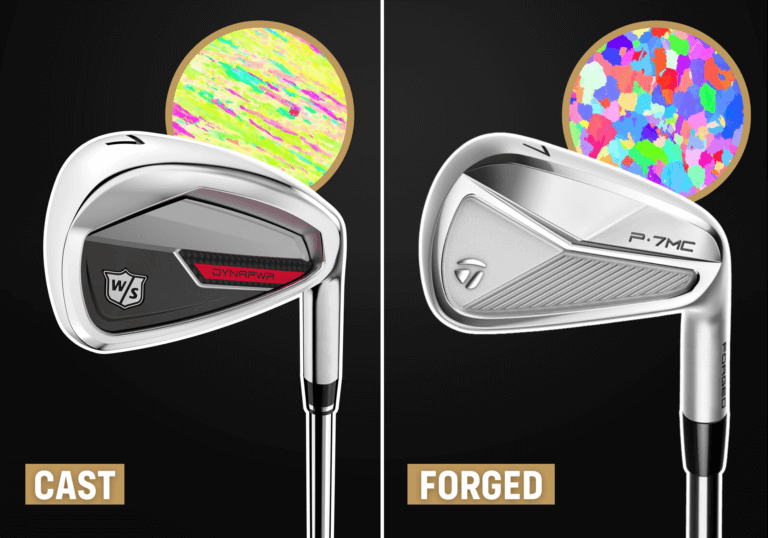
A quick look at the image generated from the electron microscope of the cast club face provides a detailed picture of this inconsistency.

What you see here is a scan of the crystal orientation of the cast club face. You’ll notice that the upper left portion of the image is entirely different, meaning the crystal orientation is different. Notice how random it is? This is because crystal orientation, and thus grain size, is largely dependent on that cooling process.
“It’s going to be random however it solidifies.” said Nowell.
In contrast, a look at the crystal orientation of a forged club face provides a model of consistency.

Notice that the crystal orientation is consistent throughout. It’s easy to see that the grains are smaller and more compact. This, too, has an impact on the integrity of the material (we’ll talk about that in a second).
The reason the forged club face is so consistent is because of the repeatability that comes with the forging process. No cooling, no heating. The metal is pressed in the same way again and again, leading to consistency at a crystallographic level from iron to iron, set to set.
“For forging, It’s a lot easier to understand and predict, if you’re always pressing on a piece of metal over and over again. the crystals in the metal will have a more consistent response. They’re going to bend the same way every time,” Nowell said.
“No matter how you forge the structure, you’re going to get this type of a final crystal orientation. So I think a set of forged clubs are going to end up to be more consistent.”
2. Smaller grains mean stronger metal
The rate at which the material is cooled has a direct effect on grain size. The more quickly the material is cooled, the smaller the grains. However, cooling too quickly can cause the material to become brittle.
That’s for casting. Forging inherently provides a smaller grain structure, as seen in the images above.
“As your grain size get smaller, that means your metal will be stronger. And I think that wasn’t completely unexpected.” said Nowell.

So why not cool cast clubs at a quicker rate to make the grain structure smaller?
“If we’re thinking only in terms of trying to match the performance of the forged club by going to a smaller grain size, that would be beneficial. The drawback to that is that it could also make the material much more brittle. So it may not be able to withstand impact,” Nowell said.

The pictures above show the clear difference in the size of the grains. Remember, the smaller the grain, the stronger the metal. As such, the forged clubs are more resistant to deforming or breaking, hence why they can be bent to different lies and lofts without snapping like a cast club would.
3. Feel is a result of how sound travels through the metal
When we talk about how a golf club feels, we’re often referring to (subconsciously or not) how it sounds when struck.
Most golfers agree (although I’m not convinced) that forged clubs feel better than cast clubs. The adjectives often used to describe forged clubs are “soft”, “buttery” or “muted.”
How the vibrations (or sound) propagate through the club are a direct result of the grains and their accompanying boundaries.
“It’s interesting because of the sound propagation through the metal. That acoustic energy is also a function of crystal orientation and so, having different orientation distributions and overall different, textures (how these orientations are created either through casting or through forging), can help explain why they will feel different,” Nowell explained.
“(They feel) differently because the sounds will be different and those vibrations will travel differently through the clubs and some of that is attenuated by the grain boundaries.”
Recap: Forged versus cast
- Casting is inconsistent, forging is consistent
- Smaller grains make for stronger metal. Forged clubs have smaller grain structures.
- Feel is a direct result of how sound travels through grains. Different grain structures between cast and forged clubs will result in a difference in “feel.”
What can we conclude?
If you’re trying to get me to say forged clubs are better than cast, you’ll be disappointed. What I can confidently say after learning from my friend Matt is that the forging process is more consistent from a quality control standpoint.
Similar to how we evaluate golf balls in our Ball Lab, manufacturing quality is important to performance. So while a forged club may not “perform” better than a cast club in the typical sense, a forged club will more than likely be more consistent, iron to iron and set to set, on a material level than its cast counterpart.
“It makes sense to me how forging would add consistency to the overall behavior of the metal, as a golf club.” Nowell concluded. “If you want a known microstructure throughout one set to the other, forging would give that to you.”









Martin N
2 years ago
Thanks for the great write-up on the club production process. It would be great if you could have a look – using the same lens – at 3D-printed clubs (Cobra released ones recently) and how this process affects the characteristics of the club.